Every year, the AI world produces more predictions than actual breakthroughs. CEOs promise that artificial general intelligence is “months away.” Researchers bet real money on millennium-prize-solving machines. And then, quietly, the calendar turns and almost nobody checks the receipts.
We did. And it turns out the people who get AI predictions right are almost never the ones making headlines. The most accurate forecasters say boring things like “not yet” and “that’s going to take longer than you think.” Nobody shares those on X.
We went through three years of AI prediction compilations on LessWrong (Jessica Taylor, an AI safety researcher, has compiled these annual roundups since 2024), Rodney Brooks’ annual scorecards running since 2018, Rob Toews’ Forbes predictions, and Gary Marcus’ Substack track record. We found 37 predictions specific enough to grade as right, wrong, or partially right.
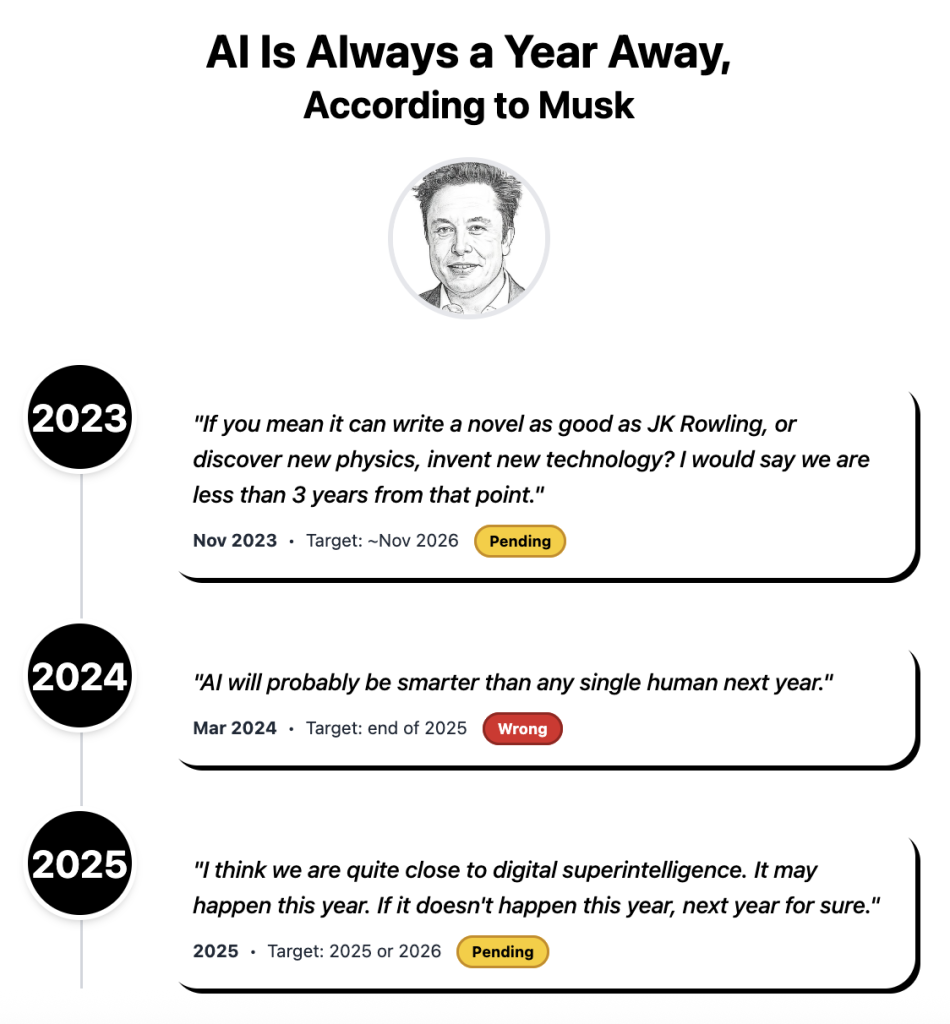
Elon Musk appears in all three LessWrong compilations. His signature move: predict AI will be “smarter than any human” by next year, watch it not happen, then make the same prediction again for the following year. He’s been doing this since at least 2023. His current record is 0 right predictions, with the same prediction now targeting 2026.
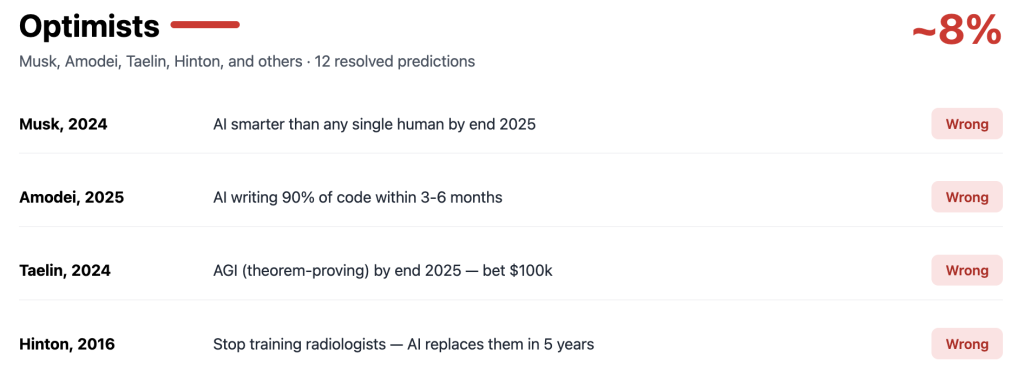
Dario Amodei, CEO of Anthropic, said in March 2025 that AI would be writing 90% of the code within months. Victor Taelin, a developer known for creating the HVM runtime, bet $100,000 that AGI would arrive by end of 2025. All wrong.
This pattern isn’t new. In 2016, Geoff Hinton told people to stop training radiologists because AI would replace them within five years. Radiology departments are hiring more than ever.
‘Pessimists’ Keep Nailing It
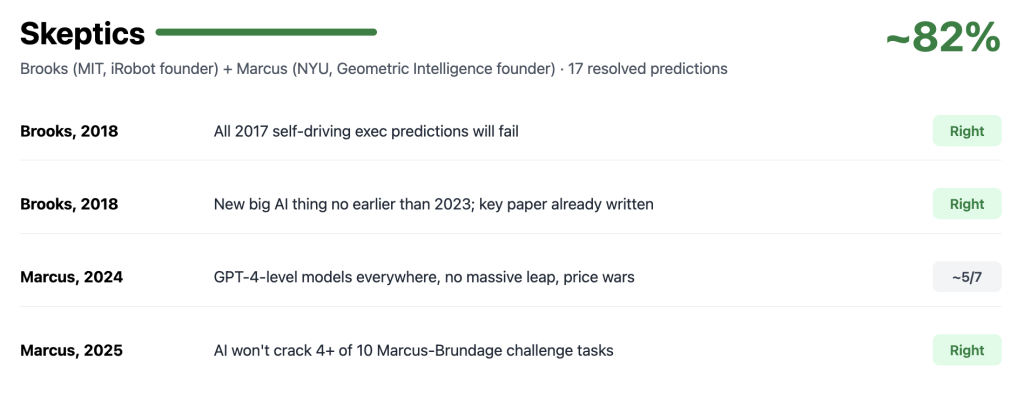
Gary Marcus, often dismissed as the guy who just doesn’t “get” AI, predicted in early 2024 that we’d see a bunch of GPT-4-level models, no massive leap, price wars, and modest corporate adoption. He got roughly five out of seven. His 2025 prediction that AI wouldn’t crack more than four of ten specific challenge tasks? Correct again.
Rodney Brooks, the MIT roboticist, has been publishing dated predictions with color-coded self-grading since 2018. His hit rate on AI and robotics claims is around 85%. His method is almost boringly simple: he looks at what the hype says, checks it against how long technology deployment has actually taken historically, and adds a generous buffer. It keeps working.
Rob Toews, writing for Forbes, lands somewhere in between — about 55% accurate. He’s good at structural industry calls (Microsoft-OpenAI tensions, Chief AI Officer roles emerging) but overshoots on adoption speed (web agents going mainstream, Meta charging for Llama).
The pattern across all 37 predictions suggests that people who say “this will be huge, soon” are almost always wrong about the “soon” part. People who say “not yet, and here’s why” keep being right.
Of course, this is a small and messy sample — 37 predictions, self-selected by one LessWrong compiler, graded with editorial judgment, biased toward attention-grabbing bullish claims. It’s also structurally unfair to the optimists: bold short-term claims get falsified fast, while cautious long-term ones haven’t been tested yet. If AGI arrives in 2028, the skeptics’ track record will look very different.
And yet, next time someone tells you AGI is 18 months away, maybe ask them: what did you predict last year, and how did that go?