
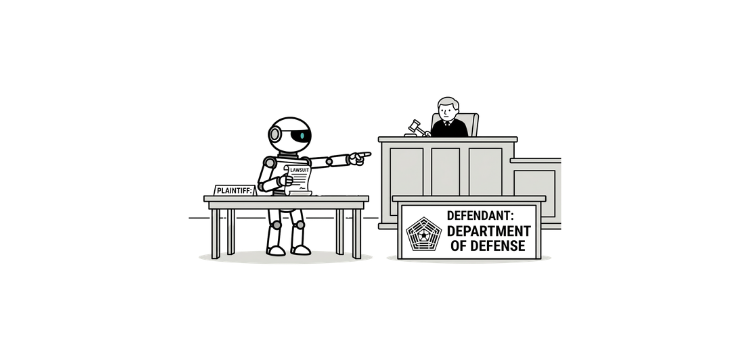
Anthropic filed two federal lawsuits against the Department of Defense on Monday, March 9, challenging the Pentagon’s decision to label the AI company a national security “supply chain risk.” The suits land in the US District Court for the Northern District of California and the DC Circuit Court of Appeals, and accuse the Pentagon of using the designation as ideological punishment rather than a genuine security measure.
What the Fight Is About
The dispute comes down to one disagreement: the Pentagon wanted unrestricted access to Claude (Anthropic’s AI model) for all lawful purposes. Anthropic refused. The company drew two hard lines: Claude would not be used for mass domestic surveillance or for fully autonomous weapons systems that make lethal decisions without human involvement.
When talks broke down in late February, Defense Secretary Pete Hegseth announced the supply chain risk designation on X on February 27. President Trump followed hours later, directing every federal agency to immediately stop using Anthropic technology. The designation forced defense contractors — including those already running Claude — to find alternatives. Anthropic had been the first AI company to run a large language model inside the military’s classified networks, through a Palantir platform cleared up to “Secret” level. That position is now at risk.
CEO Dario Amodei called the designation “legally unsound” and said Anthropic had “no choice” but to fight it in court. The company argues the supply chain risk label (a tool normally used to block foreign-linked vendors) was misapplied to punish a domestic company for refusing to drop safety policies.
OpenAI Signed a Pentagon Deal the Same Day
Hours after the February 27 designation dropped, OpenAI CEO Sam Altman announced his company had reached a new agreement with the DoD, positioning OpenAI to replace Anthropic on classified systems. Altman later admitted the deal was “rushed” and that “the optics don’t look good,” and OpenAI revised the terms days later. The revised deal includes explicit restrictions on using OpenAI models for mass domestic surveillance and autonomous weapons — the same two limits Anthropic had originally demanded from the Pentagon.
Former defense and intelligence officials have separately written to Congress asking for an investigation into the designation. A $200 million contract Anthropic won in July 2025 to prototype AI capabilities for national security now hangs in the balance while the lawsuits proceed.